


March 6, 2026
Lost in Transit: What Logistics Can Teach Us About AI
Author :
Ryan McCarty
March 6, 2026
Ryan McCarty
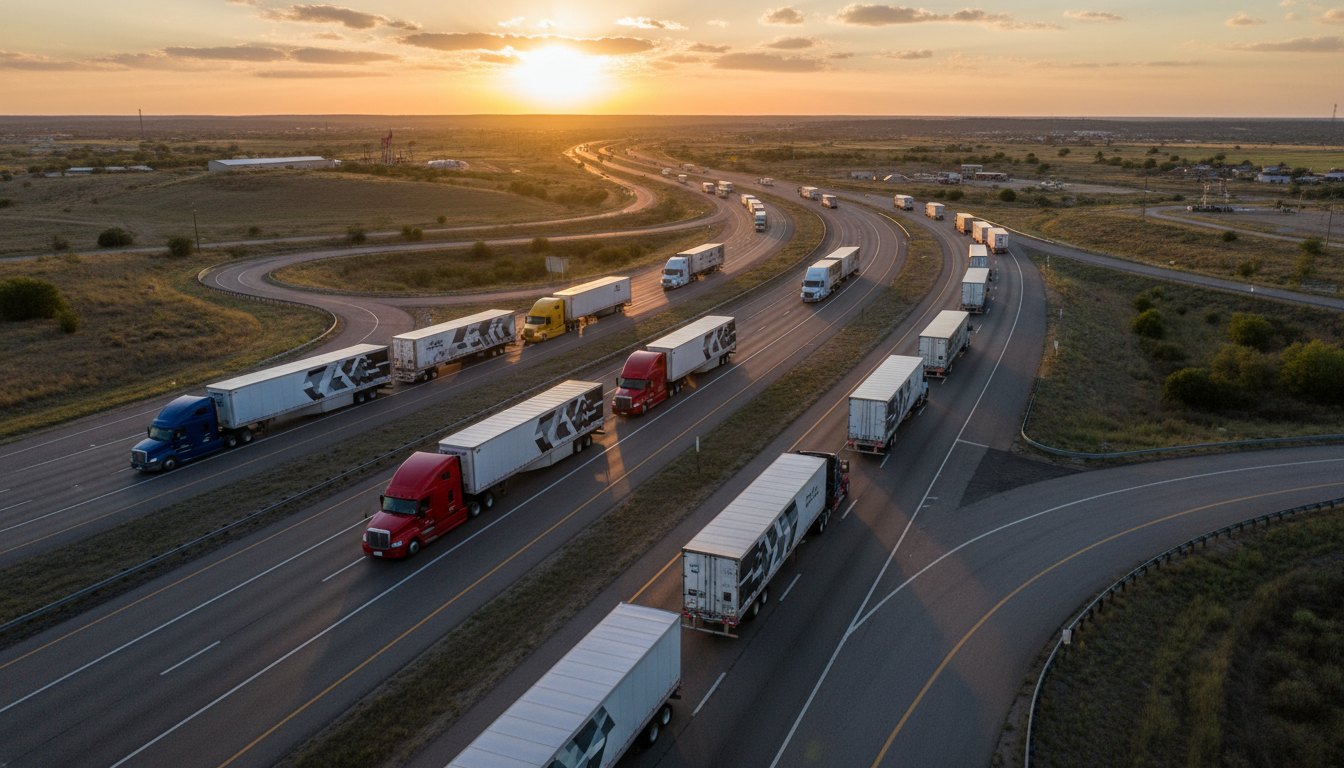
There's an old rule in freight logistics that most people outside the industry never think about: an empty truck is almost as expensive to run as a full one. Fuel, driver hours, depreciation, the costs don't scale down just because the cargo does. The only variable that changes the economics is what's inside. So the entire discipline of modern trucking comes down to one thing: making sure you know exactly what you're carrying, that it's secure, and that it's worth the move. The truck doesn’t know it’s carrying the wrong thing. It just moves. Now replace the truck with AI and the cargo with your data. The rule doesn’t change, and neither does the cost of getting it wrong.
The modern logistics industry doesn't talk much about individual trucks anymore. It talks about networks. Fleets spanning continents, warehouses distributed across time zones, weigh stations and compliance checkpoints operating under different regulatory rules in different jurisdictions. The truck is still the unit of movement, but the value isn't in the truck. It's in the coordination: knowing where everything is, what it weighs, what it's worth, and what happens if any one of those assumptions turns out to be wrong when the load arrives.
Get that coordination right and you have one of the most efficient systems humans have ever built. Get it wrong and a single miscalculation, a weight discrepancy, a mislabelled pallet, a missing certificate, can cascade quickly. The truck doesn't know it's carrying the wrong thing. It just moves.
This is a reasonable way to think about what's happening to enterprise data right now.
Most large organisations aren't running one data environment. They're running dozens. Systems accumulated through acquisitions, legacy infrastructure that was never fully replaced, cloud platforms that were stood up fast because speed mattered more than tidiness. The result looks less like a purpose-built distribution network and more like a map of ports that grew up independently and now have to pretend they were always connected.
Into this, organisations are now deploying AI. Not just as a tool that sits to the side and helps with drafts, but as an active participant in workflows. Classifying records. Making recommendations. Taking actions. The AI is the truck in this picture, and it will move what it's given. The question is whether anyone has checked the load.
In logistics, every serious operator knows that you don't just ask "is the truck moving?" You ask: is the weight accurate? Is the cargo secured? Does this shipment comply with the rules of every jurisdiction it'll pass through? Those aren't bureaucratic questions. They're the difference between a profitable run and a liability.
In data, the equivalent questions are just as specific and just as frequently skipped. Not because organisations are careless, but because the answers are scattered. Sensitivity lives in one system. Consent records live in another. Purpose limitations are buried in a policy document that nobody has linked to the table it governs. Lineage, if it's tracked at all, is tracked inconsistently. So when an AI system reaches for data to act on, it often finds the cargo but not the paperwork. It moves anyway.
The pressure to move fast is real. Competitive advantage in logistics comes from velocity, from turning loads faster, routing smarter, eliminating idle time. No serious operator argues against speed. But experienced operators also know that speed without visibility is how you get a truck that arrives at a checkpoint it was never cleared to cross.
The same principle holds as AI systems take on more operational weight. The wins are genuine. Faster classification, broader coverage, decisions at a scale no human team could match. But these wins can compound risk as well as value if the underlying data doesn't carry enough context for the system to understand what it's actually handling.
This is the part that tends to get missed in conversations about AI governance. The focus lands on access controls, model policies, approval workflows. Those matter. But a truck that's allowed to leave the depot is still a problem if the load was never properly checked before it did. The gate isn't the answer to a loading problem.
What changes this isn't more checkpoints. It's better preparation before anything moves. In logistics terms, that means a manifest that travels with the cargo: not just what it is, but where it came from, what rules govern its handling, and what changes when it crosses a new boundary.
In data terms, that's the difference between information an AI can access and information an AI can actually use responsibly. The gap between those two things is where most enterprise risk quietly accumulates. Not in dramatic failures, but in decisions that looked reasonable from the outside and turned out to be wrong in ways that only became visible later.
The expansion of AI into operational workflows isn't slowing down. Neither is the complexity of the data environments those systems are being asked to navigate. The organisations that fare better aren't necessarily the ones moving fastest. They're the ones that figured out what was in the truck before they sent it.
Share


Dead Reckoning: How Enterprise AI Drifts Off Course Without Continuous Validation
All Industries
March 20, 2026
Lost in Transit: What Logistics Can Teach Us About AI
All Industries
March 6, 2026

A New Chapter Begins: 1touch + Everpure
All Industries
February 23, 2026